

We are delighted to introduce the feature film BILLIE, opening in German cinemas on 17 September 2026.
BILLIE, beyond representation and shaping new visual narratives. A significant moment for German cinema unfolds on screen: BILLIE places two actresses of African heritage at the heart of a German feature film and brings together a distinctive visual language shaped by diverse cultural perspectives. Behind the camera, numerous Black creatives hold key positions – including the costume department – contributing not only to who is represented, but to who helps shape the visual language of the film.
At the centre of BILLIE are two friends whose everyday lives are suddenly thrown into chaos. After getting stuck in a bank over €300, they unexpectedly find themselves mistaken for bank robbers. What begins as an absurd situation unfolds into a story about friendship, solidarity and self-determination – told with humour, warmth and a good dose of chaos.
But BILLIE tells another story through its images: the story of what happens when cultural perspectives are not treated as something that needs to be explained or translated, but become part of the creative process itself.
As Head of Costume Design, I worked with the costume department to develop the visual world of the characters. The intention was never to simply find “African” clothing for a German film.
Before the first fabric was selected, there were already colours, textures, silhouettes and memories. Director Sheri Hagen had a clear vision for the world of the film. From that vision, and through a close engagement with the characters, emerged an aesthetic that brings different lived realities into conversation.
African Fashion, contemporary design, vintage, Afropunk and material innovation.

African Fashion is contemporary fashion – diverse, innovative, artistic, spiritual and constantly evolving, shaped by designers across the African continent and throughout the diaspora.
Its visual languages encompass distinctive silhouettes, high end, tailoring, street couture, craftsmanship, subculture, material innovation and avant-garde approaches to design. It is created wherever African and Afrodiasporic designers develop their own references, aesthetics and codes.
Not simply as a counter-narrative to Western fashion, but as an integral part of contemporary fashion and its evolving history.
This perspective also informed the costume design for BILLIE. Among other things, the following items were designed specifically for the film: a bag, arm and leg warmers made from banana fibres, designed by Paul Kadjo. Other garments were custom-made and draw on textile traditions of the aesthetics of Nigerian Swiss lace.
What interests me is what happens when cultural references are not used as decoration, but become connected to the personality and inner world of a character.
The Ankh: A Symbol of Life, Legacy and Continuity
Long before many of the histories we know today were written, Kemet was already a centre of knowledge, spirituality and creative expression. Before almost everything the Western world considers “civilization,” there was Kemet. And at the center of its spiritual life was the Ankh.
The Ankh is one of the most ancient symbols in human history.
In the visual language of BILLIE, the Ankh becomes more than a symbol. It becomes a connection between history, identity and the present. For generations, the symbol has travelled far beyond its ancient context. Across the African diaspora, the Ankh has been embraced in jewellery, fashion, art, music and pop culture – not simply as an historical reference, but as a living sign of connection and continuity.
For Angie, for example, the Ankh becomes a distinctive visual part of her story. The ancient symbol, rooted in Kemet – the ancient Egyptian name for the land of Egypt – is associated with life and, within the costume design, becomes connected to Angie’s energy, her determination to change and her passion for life.
Angie also wears shoes by the Senegalese label Nio Far – a name derived from the Wolof language and expressing the idea of “we are one” or “we belong together”. Here again, a seemingly small detail becomes a carrier of meaning: a shoe becomes a symbol of connection, community and the strength of togetherness.
A small sign can suddenly carry an entire story.
For Rahel, the costume design draws inspiration from artist Uniity a unique visual identity of the Afropunk movement – a space where individuality, resistance and self-expression become part of the aesthetic.
Afropunk: When Style Becomes Self-Determination
Afropunk emerged at the intersection of music, art, film, fashion and activism – a cultural space shaped by young, gifted people who refused to be contained by the categories available to them. For an Afrodiasporic generation navigating multiple cultural references, identities and histories, Afropunk offered something powerful: the possibility of defining oneself rather than being defined from the outside. Afropunk has always been difficult to place within a single genre. Hip-hop, punk, jazz, fashion and activism intersect within its visual and cultural language. Its significance lies precisely in this refusal to conform: to one sound, one aesthetic, one identity or one definition of Blackness.
Who gets to define how Blackness looks, sounds and occupies space?
From an Afrodiasporic perspective, this question carries particular weight. Diasporic identities are shaped by movement, displacement, memory, exchange and reinvention. Culture does not remain fixed in one place. It travels, transforms and returns in new forms. Afropunk embodies this process – not as a search for a single, authentic expression of Blackness, but as an insistence that Black identity can be plural, contradictory, evolving and entirely self-defined.
This connects Afropunk to longer histories of Black self-determination. Natural hair, locs, braids and afros challenged dominant beauty standards and affirmed the beauty of Black bodies on their own terms. African fabrics, symbols and references became ways of reconnecting with heritage while simultaneously creating something new. But Afropunk is more than a language of resistance.
It is also a language of possibility and occupy space.
Its significance lies in the freedom to draw from multiple worlds without having to explain or justify the connection between them. Heritage can meet futurism. Vulnerability can coexist with defiance. Individuality can exist alongside community. African and diasporic references can be reimagined rather than simply preserved.
This is where Afropunk becomes particularly relevant to contemporary fashion. Its aesthetics are not rebellion for rebellion’s sake. They emerge from a deeper act of authorship: the ability to construct one’s own visual vocabulary and to decide what identity looks like in the present.
For an Afrodiasporic perspective, fashion therefore becomes more than representation. It becomes a site of cultural negotiation, memory and self-determination.
Another character is Felix, a young, hip and stylish influencer who is constantly immersed in the digital world – always filming, capturing and sharing everything around him – gradually loses sight of what is happening beyond the screen. His look reflects this tension: he wears a T-shirt emblazoned with the words “Wear Your Values.”
The statement functions as more than a fashion slogan. It becomes a subtle question directed at the character himself and audience: “What values do we, as a democratic society, actually live by?”
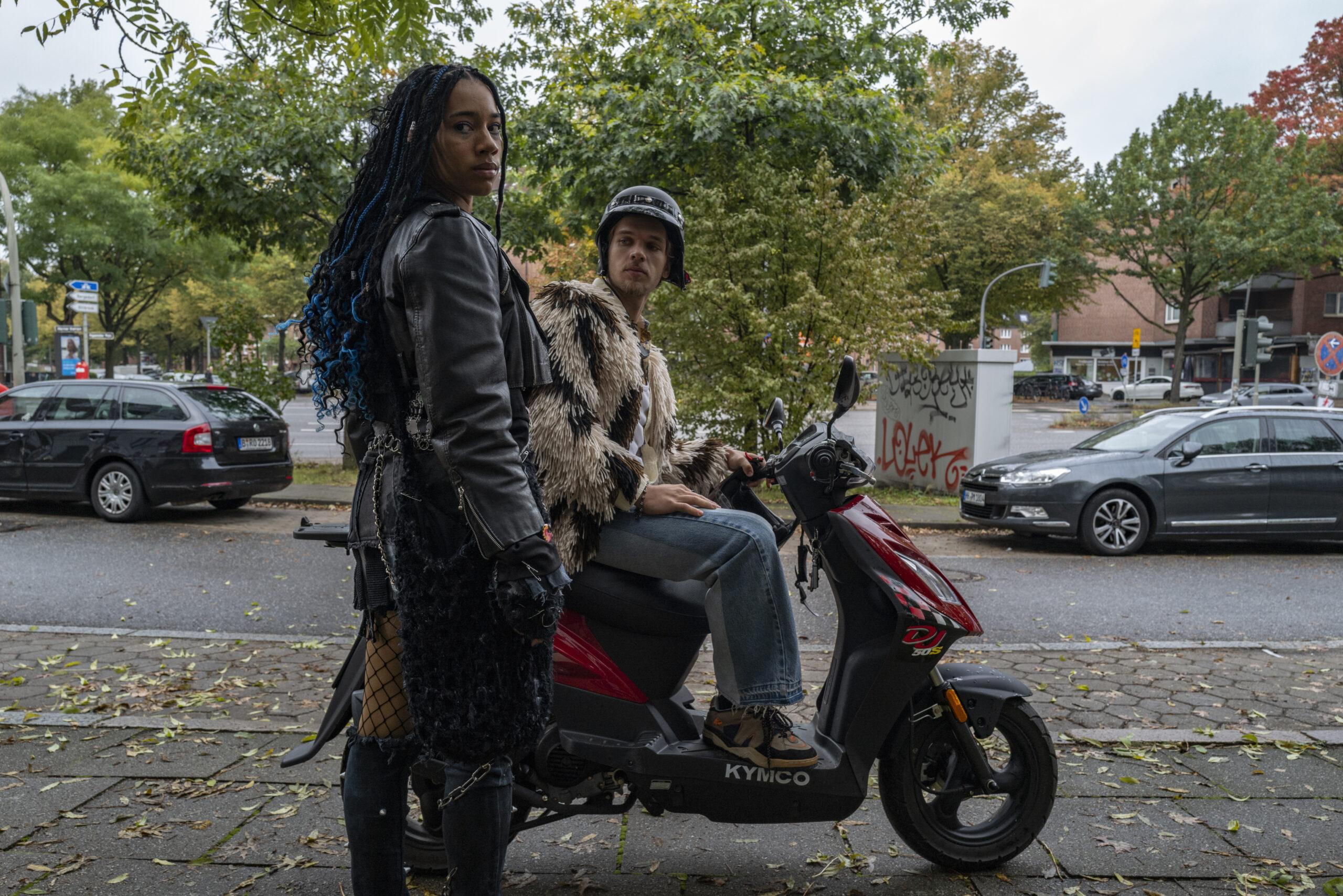
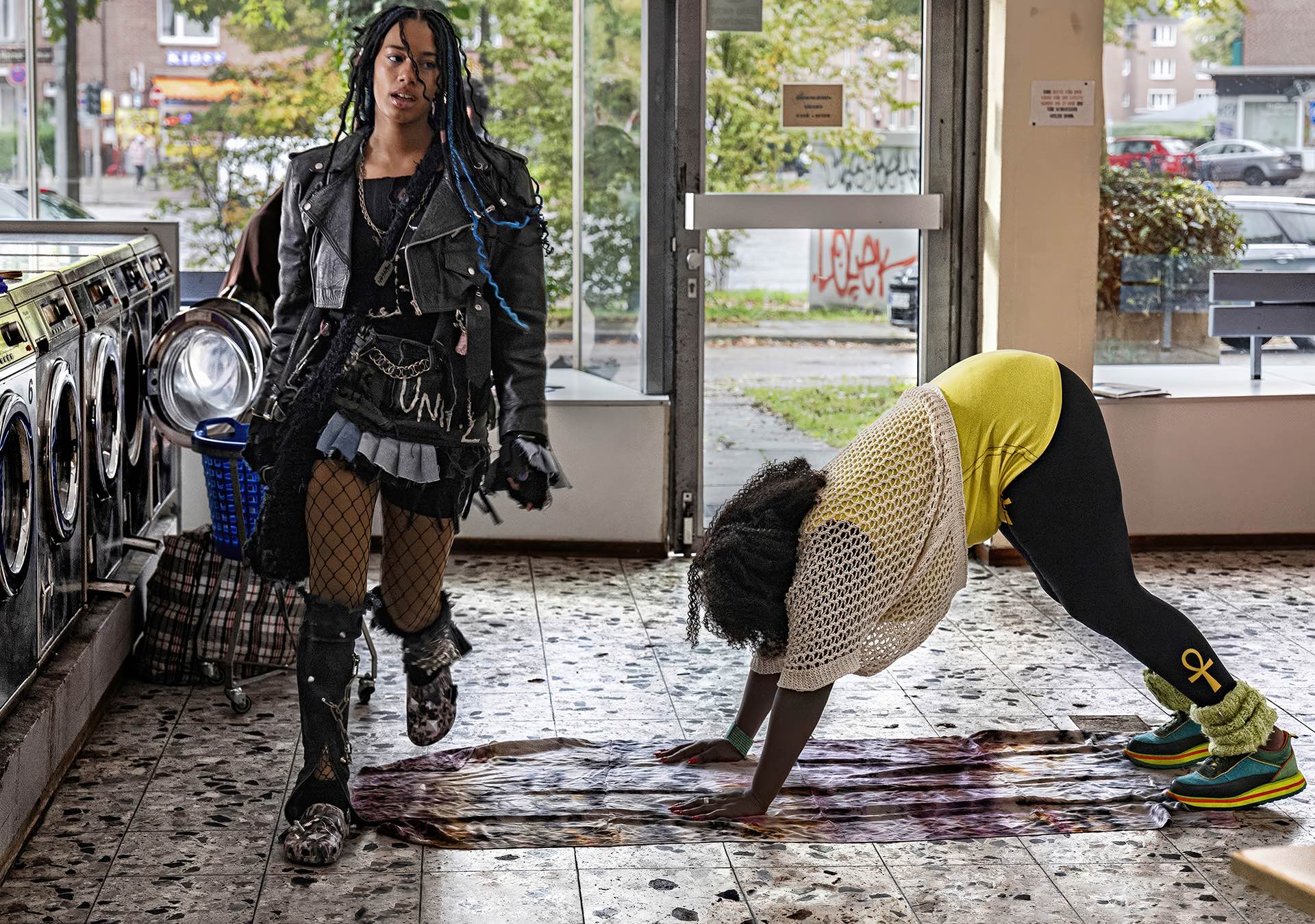

These references are not simply visual quotations. They become part of the characters identities and help create a visual world that feels lived-in rather than constructed from stereotypes.
My own Afrodiasporic perspective is an additional creative resource – never a limitation. It brings different references, visual languages and stories into my work and opens up new creative possibilities. At the same time, it allows me to move freely across different aesthetics.
A character does not have to fit into a cultural image. The image has to fit the character.
That is why African Fashion can appear in BILLIE with confidence, natural and self-assured: as what it already is – contemporary fashion with its own silhouettes, materials, references and visual codes.
Not as exoticism.
Not as decoration.
But as part of the contemporary fashion landscape.
That is the power of costume design.
Clothing speaks before a character does.
A colour can make an inner movement visible.
A silhouette can express attitude.
A material can carry memory.
A symbol can connect heritage and the present.
Identity is not a costume.
But costume can make identity visible.
BILLIE
German theatrical release: 17 September 2026
Germany 2025 | 108 min.
Directed by Sheri Hagen
The film premiered at Filmfest Hamburg in 2025, was subsequently screened at, among others, the Max Ophüls Preis, and was awarded Best Feature Film at the Pan African Film & Arts Festival in 2026.
Cast
Ruby Commey
Thelma Buabeng
Timo Jacobs
Sannrae Rehnström
Joy Ewulu
Patrick Abozen
Anne Schäfer
Credits
Produktion: Equality Film
Regie: Sheri Hagen
Kamera: Cal Ola
Deutscher Verleih: Apollo Film
Sales & Distribution: Barnsteiner Film
Costume Department
Head of Costume Design: Beatrace Oola
Costume Assistant: Paul Kadjo
Tailor / Designer: Tabitha Minott
Wardrobe & Temporary Assistant: Mirjana Ikuye
Costume Design Intern: Mardjane Moussa
Curated Selection of Designers
In Jewls – Nina
Nio Far by Milcos – Angie
Paul Kadjo – Rahel
Etuk Atelier – Friedrich
Buki Akomolafe – Frau Müller
Emeka Suits – Felix
Meriem Lebdiri – Zada
Alexandra Tamele, former fashion designer – Maya
Photography: Hardy Brackmann
Read more on Fashion Africa Now.